Please see a copy of the recent notice given to all residents in flood-prone areas. This document was prepared in cooperation with the Borough of Hillsdale Office of Emergency Management.
On behalf of the Hillsdale Emergency Services, we would like to remind you of our flood notification process.
This neighborhood is prone to flooding, and below are recommendations so you can be notified in an appropriate manner.
SwiftReach/Reverse 911
- To sign up for SwiftReach/Reverse 911, please go to www.HillsdaleNJ.org and click on the SwiftReach/Reverse 911 tab. This service will place a phone call, text message, and e-mail to you directly when the Pascack Brook reaches Flood Stage 1 & 2 (3.5 feet & 4.5 feet). Please sign up for voice/text/email.
- Follow the Office of Emergency Management & the Police Department on Facebook, Instagram, and Twitter for information regarding current and upcoming weather events. A post will be created to notify residents. Due to these events' ongoing and fluid nature, these posts will not be updated with real-time information.
- Sign up for the Borough of Hillsdale e-mail notifications by going to www.HillsdaleNJ.org and scrolling down to ‘What’s Happening Now.’
Flood Stages
- Flood Stage 1 is when the Pascack Brook reaches 3.5 feet. At this time, the Police Department will begin making notifications as flooding is possible. The flood siren will go off, and a voice message will follow directly after. The Police Department or Fire Department will drive through the flood-prone areas and notify residents via PA notifications. Also, the Police Department administration, the Chief of the Fire Department, the DPW superintendent, the Borough Administrator, and the Mayor will all be notified by the police department.
We highly recommend at Flood Stage 1 that you move your vehicles to higher ground since experience has shown us that flood levels can rise quickly.
- Flood Stage 2 is when the Pascack Brook reaches 4.5 feet. At this time, another flood siren will go off, followed directly by a voice message.
- Flood Emergency is when the Pascack Brook water has crested the banks. Again, a flood siren will go off, and a voice message will follow. Flood Emergency is the most severe notification, and significant flooding is imminent.
Residents are strongly advised to leave their houses at Flood Stage 1. During a Flood Emergency, there is no guarantee that first responders can get to your house with a boat and help you to safety.
Hillsdale Police Department Body Worn Camera Deployment
Monday, February 28, 2022 - 13:03
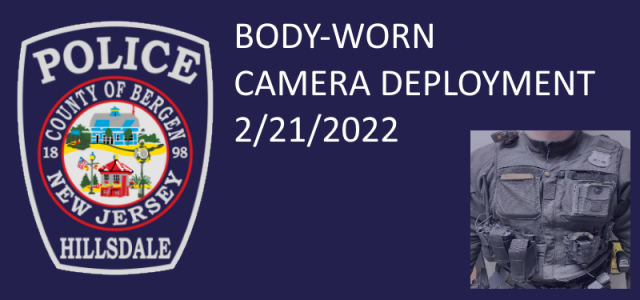
As of February 21, 2022, the Hillsdale Police Department has implemented body-worn cameras. All patrol units have been outfitted with these devices, and currently utilize them in all official law enforcement duties. The footage captured by our officers will preserve interactions with the public, capture evidence to use in cases, and assist in the investigation of motor vehicle offenses. Body-worn cameras provide training points to assess officer safety, best procedural practice, and interactions with the public.
Body-worn camera video is similar to cell phone cameras. The unit will be attached to an officer’s uniform or external vest carrier. The camera will record in the direction the officer is facing and will capture audio and video within the camera’s field of vision. Members of the public who interact with officers will be recorded on body camera video. Officers will notify citizens when the camera is recording, which then an individual can request the camera be deactivated. It will be at the officer’s discretion whether it is appropriate to deactivate the device.
Body-worn cameras are proven to:
PRESS RELEASE: Hillsdale Police Accreditation
Monday, January 11, 2021 - 14:05
PRESS RELEASE
FOR IMMEDIATE RELEASE
Accreditation Assessment Team Invites Public Comment
(Hillsdale, Bergen County NJ) A team of assessors from the New Jersey State Association of Chiefs of Police (NJSACOP) on Monday, January 18th, 2021, will examine all aspects of the Hillsdale Police Department’s policies and procedures, management, operations, and support services Chief Robert Francaviglia announced today.
“Verification by the team that the Hillsdale Police Department’s meets the Commission’s “best practice” standards is part of a voluntary process to achieve accreditation, a highly prized recognition of law enforcement professional excellence”, Chief Robert Francaviglia said.
As part of this final on-site assessment, employees and members of the general public are invited to provide comments to the assessment team. They may do so by telephone or email. The public may call (609) 432-0868 on Monday, January 18th, 2021, between the hours of 10:00 AM and 11:00 AM. Email comments can be sent to SSmith@HillsdalePolice.com
Telephone comments are limited to 5 minutes and must address the agency’s ability to comply with the NJSACOP standards. Please contact Captain Sean Smith at (201) 664-4200 for information about the standards.
Hiring Announcement Fulltime and Substitute Crossing Guards
Tuesday, November 17, 2020 - 08:08
The Hillsdale Police Department currently has job openings for the position of “Crossing Guard”. This is an open application process with no expiration at this time.
Hourly Rate: Currently $21.00 per hour.
Positions Available: Full time and substitute guards.
Requirements: Minimum 18 years old, valid driver’s license, good moral character.
Hours: approximately 3-4.25 hours per day depending on schedule.
Please contact Lou Spagnoli at the Hillsdale Police Department for an application or questions.
201-497-1539
The Borough of Hillsdale is an equal employment opportunity employer. Borough and Department policies prohibit discrimination against employees on the basis of race, color, sex, age, religion, national origin or ancestry, marital status, parental status, sexual orientation, military service, disability, gender identity, and other classifications protected by law. These policies also prohibit discrimination in the form of harassment of an individual on the basis of a protected classification.
Contact Us
Borough of Hillsdale Police Department
380 Hillsdale Ave
Hillsdale, NJ 07642
201-664-4200
201-666-4503 (FAX)
Zircon - This is a contributing Drupal Theme
Design by
WeebPal.